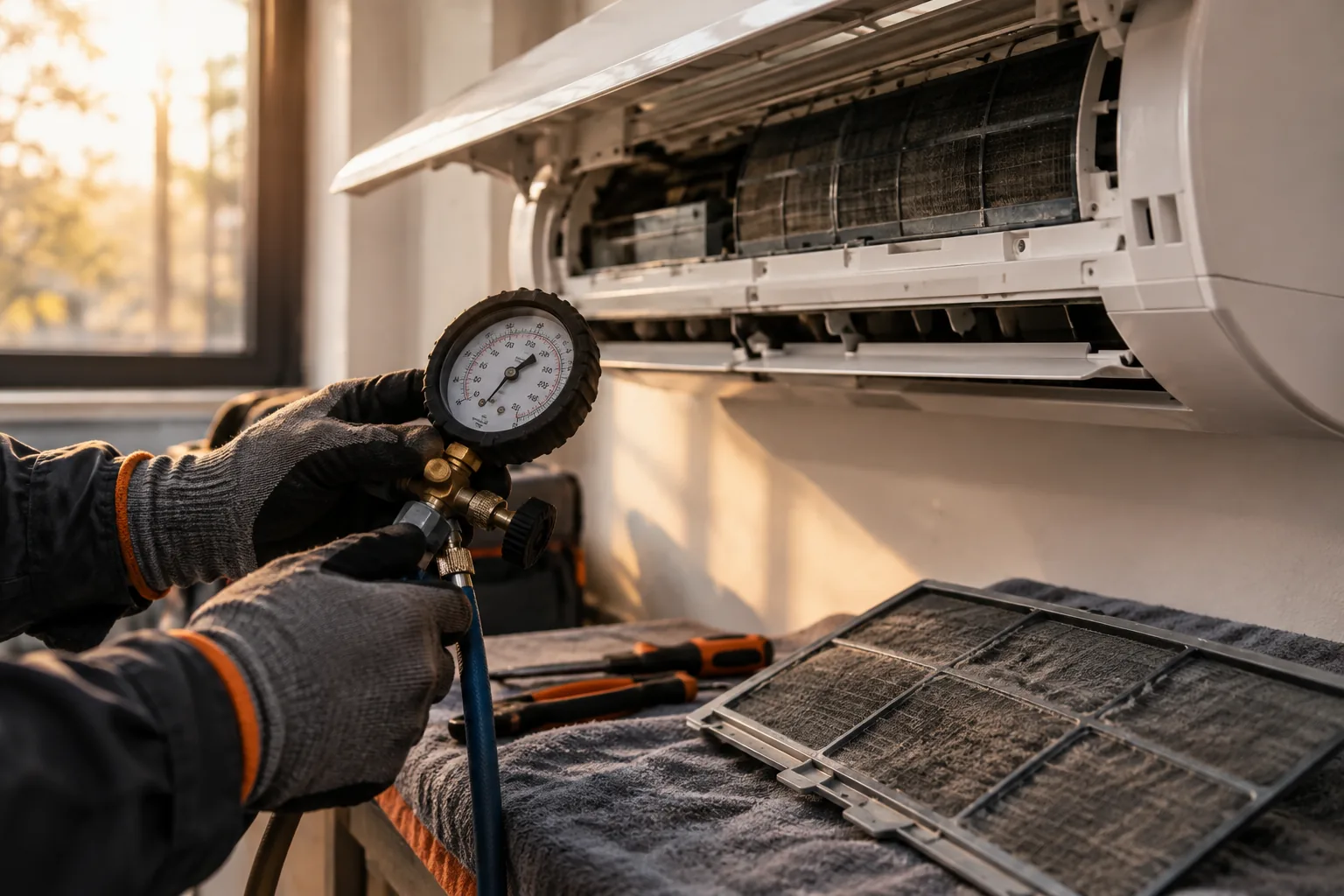
Not cooling, leaking water, ice on the pipes, a new noise, an error code or a tripping breaker each have a short list of usual causes. You can check the remote settings, note any error code and look at the breaker's position. Leave covers, wiring and the refrigerant circuit alone, and request a fault check.
Six symptoms, and what each one usually points to
Find the row that matches what you're seeing. The columns on the right tell you what you can look at and when to request a fault check. This is a guide to the usual suspects, not a diagnosis. Somebody has to see the unit for that.
Everything in the table is for things you can see from the floor or the ground, with dry hands. If you'd need a chair, a ladder or a lean over a wall, skip it and request a fault check.
| What you notice | Usual causes | You can look at | Request a fault check when |
|---|---|---|---|
| Runs, but the room stays warm | Wrong remote mode, tripped breaker, dirty filter, dirty outdoor coil, low refrigerant charge, an undersized unit | Remote set to Cool, fresh remote batteries, the breaker's position | It's still warm after those checks |
| Water inside, on the floor or wall | Blocked drain, iced-up coil melting, damaged drain pan, loose drain connection, incorrectly mounted indoor unit, poorly routed drain | Where the water is, from a safe distance | Water is near anything electrical, comes through the ceiling, or keeps happening |
| Ice or frost on the pipes | Airflow restricted by a dirty filter, or a low refrigerant charge | Leave the unit off so the ice can melt | The ice comes back |
| A new rattle, buzz, hiss or grind | Loose panel or screw, debris in the outdoor unit, worn fan bearing, electrical or compressor trouble, refrigerant leak | Listen from a distance. Do not open, tighten or reach into anything | Any new noise that continues |
| An error code or flashing light | Some are simple reminders, some are real faults | Write down the code, check your manual | The code stays |
| Trips the breaker | An overload, short circuit or earth-leakage fault, depending on the device | The breaker's position. If it has tripped, leave it off | Every time the aircon trips it |
Turning a unit off at the remote stops it running. It does not isolate it electrically, so it is not preparation for any physical check.
Where the owner checks end
Everything on this page stops at the same four places.
-
Refrigerant. Work on the refrigerant circuit needs an SAQCC Gas registered practitioner. Topping up, leak repair and anything that opens the pipes all sit on that circuit. Never handle refrigerant yourself. A bottle from a hardware shop is not a repair.
-
Wiring, covers and the board. Do not remove covers, open the unit's electrical panel or open the distribution board.
- The outdoor unit. From the ground, you can look for an obstruction without touching the unit. Do not remove covers, tighten mountings, move or level the unit, or clean its coil. Do not climb a ladder, lean over a wall or stand on a bracket to reach it. Check your body corporate or estate rules too, because some limit who may work on the outside of a building.
- The coil. Leave it alone. The fins bend at a touch.
Not cooling: check the remote and the breaker first
Most of this takes a few minutes and no tools. Put the remote on Cool, shown by the snowflake. For normal room cooling, select Cool mode. Dry mode is intended mainly for dehumidification, and Fan and Heat modes won't cool the room, so check it isn't on Heat. Set the temperature below the room temperature and put the fan on Auto or High. If the remote doesn't respond, try fresh batteries. ServiceLink SA's checklist has the same start.
Then look at the breaker marked for the aircon. You are looking at its position only. If it has tripped, the section on breakers below applies.
The filter is the one part some units let you clean. Do it only as the manual directs, from the floor, after the unit is safely switched off at its isolator. If you can't reach it from the floor, or the manual doesn't say the filter is user-removable, leave it for the technician. Let a washed filter dry fully before it goes back.
If the room is still warm, the next suspects are a blocked condenser, a frozen coil, a refrigerant leak or an undersized unit (Cape Air Conditioning, a South African installer). The last three are not owner jobs, and neither is the condenser.
Water inside: keep away from electrics first
An aircon pulls moisture out of the air, and that water is meant to leave through a drain pipe. In cooling mode, water normally leaves through the indoor unit's condensate drain. When it drips from the indoor unit instead, ServiceLink SA calls a blocked drain pipe the most common reason. Fine dust, algae and slime build up until the line can't carry the water away.
A blocked drain isn't the only way in. A dirty filter or low refrigerant can ice up the coil, and when the ice melts it can overflow the drain pan. A damaged drain pan, a loose drain connection, an incorrectly mounted indoor unit or a poorly routed drain can also cause leakage. Verda Vento, a Cape Town installer, says poor installation is very common in South Africa.
Keep away if water is near electrical equipment. Do not touch wet switches, plugs or the unit. Arrange a safe electrical assessment.
After a flood, or if the unit has been exposed to floodwater: do not switch on a flood-exposed aircon. Have the electrical supply and the aircon assessed before it is used again.
Outdoor-unit water is a different question. Outdoor-unit water can occur during heating and defrost. The operating mode and the source of the water matter, so unexplained water at the outdoor unit is worth a fault check rather than a shrug.
Where the guides disagree is flushing the drain line. One SA site walks owners through it, another says it's for experts. We'd hand that one over.
Request a fault check when water is coming through the ceiling rather than from the unit, when it carries on after the unit has been looked at, when the pan or pipe looks damaged, or when there's a foul smell or mould near the unit.
Ice on the pipes: let it melt, then work out why it froze
Frost on the copper pipes or the indoor coil means the coil has dropped below freezing. Cape Air Conditioning lists frost on the refrigerant tubing, weak cooling and extra water from the drain as the signs. ServiceLink SA names two usual reasons: restricted airflow from a dirty filter, and low refrigerant.
Leave the unit off and give the ice time to melt. This is about abnormal icing while the unit is cooling. Frost on the outdoor coil in heating mode is a different issue.
If the ice returns after the unit has fully thawed and the filter has been checked, leave it off and request diagnosis. ServiceLink SA puts "ice returns immediately after melting" on its list of reasons to call a technician. A low charge can result from a leak or an incorrect previous charge, so the cause needs diagnosis before refrigerant is added. That is covered on our aircon regas and leak repair page.
A new noise tells you how fast to switch off
Sound is a useful clue, because the cheap causes and the expensive ones sound different.
A rattle or vibration is usually mechanical and loose: a front panel or filter that isn't seated, a screw that's worked free, or debris in the outdoor unit. Those are the technician's to put right. Do not tighten, open or reach into anything yourself.
Banging, grinding, buzzing without the fan turning, hissing: turn the unit off and request a fault check. ServiceLink SA's advice for grinding is not to run the unit.
A tripping breaker or an error code is a stop sign
Look at the breaker's position. If the aircon trips it, leave it off and request a fault check. Do not repeatedly reset it or open the distribution board.
A tripped protective device can indicate an overload, short circuit or earth-leakage fault, depending on the device. HVAC guides, mostly from the US and Australia, name a dirty outdoor coil, a weak starting capacitor and a struggling compressor as common culprits. ServiceLink SA lists capacitor and compressor faults among the causes of clicking and buzzing. All of these need testing with proper equipment.
Burning smell, a hot or scorched breaker or plug, a buzz with no fan turning: don't touch the breaker or the isolator. Keep everyone away from the unit and call a qualified electrician. Don't reset anything.
Error codes are less scary than they look. Some are just reminders. Samsung South Africa's support page says its indoor units show "CF" when the filter needs cleaning, and you reset the reminder afterwards. For any other code, write it down exactly, note the brand and model, and tell us when we call. The manual lists what each code means for that model.
Repair or replace: compare like for like
There is no single number that settles it. Ask for a repair quote and a like-for-like replacement quote. Compare their full scope, the unit's condition, repeated faults and whether it is correctly sized.
Repeat failures matter, and so does a unit that was too small for the room from day one. Cape Air Conditioning lists an undersized unit as a cause of poor cooling, and a repair can't change a unit's size. A cheap repair on a sound unit is often worth doing. Several big ones in a row on an old unit often aren't.
Our aircon installation cost page shows what moves the price of a replacement, with each source and date beside its figures.
What a repair visit costs: one published example
A fair price needs a look at the fault. Here is what one operator publishes for the first step, the call-out and diagnosis. Use it to know what to ask about, then compare quotes with the same scope.
| Source and date | Call-out | Diagnostic fee |
|---|---|---|
| ServiceLink SA, published 10 April 2026 | R300 to R600; most companies waive it if you go ahead | R300 to R600, charged by some if you decline the repair |
One source is a sense of scale, not a tariff. Any price for your unit needs somebody to look at it.
Also on this site
- A low charge and leaks: aircon regas and leak repair
- Keeping it from breaking in the first place: aircon service and maintenance
- Past repairing: aircon installation and aircon installation cost
- Areas: Johannesburg · Pretoria · Centurion · Sandton · Randburg · Midrand
- Contact
Questions people ask
Why is my aircon running but not cooling?
Start with the remote on Cool and the breaker's position. If it's still warm, the cause may be a dirty outdoor coil, a frozen coil, low refrigerant or an undersized unit, and the next step is a fault check.
Is it normal for the outdoor unit to drip water?
In cooling mode, water normally leaves through the indoor unit's condensate drain. Outdoor-unit water can occur during heating and defrost, so the operating mode and the source of the water matter. Water from the indoor unit or the ceiling is not normal and usually points to a blocked drain, a frozen coil or a drain fault.
Can I top up the gas myself?
No. Work on the refrigerant circuit needs an SAQCC Gas registered practitioner. A low charge can result from a leak or an incorrect previous charge, so the cause needs diagnosis before refrigerant is added.
How many times can I reset the breaker?
Don't. If the aircon trips a breaker, leave it off and request a fault check. Do not repeatedly reset it or open the distribution board. If water or a burning smell came first, keep away from it.
Is it worth repairing an old aircon?
Often, if the fault is small and the unit was the right size. Ask for a repair quote and a like-for-like replacement quote, and compare scope, the unit's condition, repeated faults and sizing.
How much does an aircon repair cost?
ServiceLink SA lists a call-out of R300 to R600 (published 10 April 2026). The repair itself depends on the fault, so a price needs a look at the unit.
Does the brand of my aircon matter?
Yes, a little. The brand and model tell the technician which parts and error codes to expect, and your manual lists what each code means for that model. Give both when you request a quote.
Sources for the figures and rules on this page
Checked 2026-11-09. Each is one operator's published advice unless stated.
- Not-cooling checks (remote on Cool/snowflake, temperature below room, fan Auto or High, causes list), "ice returns immediately after melting", repeated breaker trips and burning smell as reasons to call, oily residue as a visible leak: ServiceLink SA, published 9 April 2026: . Remote batteries is plain advice, not from ServiceLink. servicelinksa.co.za (opens in a new tab)
- Blocked drain pipe most common cause of indoor leaks; filter and low refrigerant causing freeze-and-flood; poor installation, cracked pan, loose pipe; water through ceiling = call: ServiceLink SA, published 9 April 2026 servicelinksa.co.za (opens in a new tab)
- Poor installation "very prevalent in South Africa"; sources disagree on owner drain flushing: Verda Vento (Cape Town), dated 29 September, year not stated verdavento.co.za (opens in a new tab)
- Noise table (rattle, grind "do not run the unit", hiss, capacitor and compressor faults among causes of clicking and buzzing): ServiceLink SA, published 9 April 2026 servicelinksa.co.za (opens in a new tab)
- Causes of poor cooling (blocked condenser, frozen coil with frost on tubing, refrigerant leak, undersized unit): Cape Air Conditioning, 24 May 2024 capeairconditioning.co.za (opens in a new tab)
- "CF" code is a filter-cleaning reminder; filter care; disconnect power before cleaning: Samsung South Africa, last updated 13 October 2020 samsung.com (opens in a new tab)
- Breaker trip causes (dirty condenser coil, weak capacitor, failing compressor; do not keep resetting), general HVAC guides, mostly US and Australian, illustration only: and fourseasonsheatingcooling.com (opens in a new tab) frozoneair.com.au (opens in a new tab)
- Ice on the coil: leave off to defrost, Carrier (US), illustration only: . Causes (dirty filter, low refrigerant): ServiceLink SA above. carrier.com (opens in a new tab)
- Call-out R300 to R600, most waive if you proceed; diagnostic fee R300 to R600 if you don't proceed with the repair, charged by some technicians: ServiceLink SA service-cost page, published 10 April 2026 servicelinksa.co.za (opens in a new tab)
- Refrigerant work needs an SAQCC Gas registered practitioner: SAQCC Gas, SARACCA registration category page, checked 2026-11-09 saqccgas.co.za (opens in a new tab)
- Refrigerant is not used up in normal operation: Engico, 30 August 2026 engico.co.za (opens in a new tab)